We use cookies to enhance your user experience. By clicking ‘Accept’, you agree to store cookies on your device. Find our Privacy Policy.
MLA Question bank

Prepare for the UKMLA AKT, CPSA and OSCE with our all-in-one question bank, OSCE mark schemes and doctor-written notes using cutting-edge technology.

Trusted by over 100,000 medical students
Plans
Select Your Plan

Clinical and MLA AKT Qbank
£39.99/annually
Get Access 11,000+ Clinical Questions
- 3,000 Basic Science Questions
- 15,000 Anki style Flashcards
- 100 hours of Video Tutorials
- Four MLA Mock Tests
- Seven PSA Mock Tests
- Online Group Study Mode
- Offline iOS/Android/iPad App

AKT and CPSA Bundle
£59.99/annually
Get Access- Full access to Qbank (AKT)
- Full access to OSCE (CPSA)
- Offline iOS/Android/iPad App

OSCE and MLA CPSA Bank
£29.99/annually
Get Access- 350+ OSCE Stations
- Full Curriculum Coverage
- Progress Tracking Dashboard
- Online Group Study Mode
- 35+ OSCE Videos
- Offline iOS/Android/iPad App
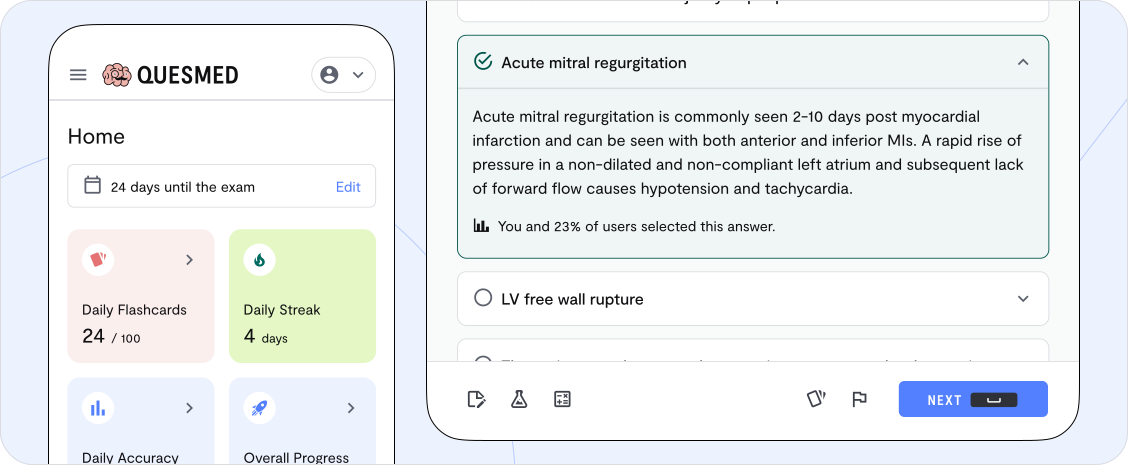
A next generation Question Bankwith thousands of questions, flashcards, videos and notes

Clinical & MLA Question Bank
Clinical Practice Questions with full MLA Coverage

10,000 Clinical Questions
Practice makes perfect with our high quality questions. Each answer choice has its own explanation to help you learn more effectively.
UKMLA preparation
Our detailed question curriculum matches the UKMLA content map, covering all 311 conditions and 212 presentations. You can choose and tick off relevant concepts or try our growing collection of realistic UKMLA mocks.

AI Study Assistant
Every question is powered by Tutor, an AI assistant that knows the question and the answer you chose. Use it to understand the reasoning, ask follow-up questions or test yourself further on the topic.
65+ Mock Tests and PSA Practice Exams
We have 12 carefully curated UKMLA mocks and 5 PSA mock tests mimicking the real exam format and structure which are perfect for clinical medical students. There are also over 50 university-specific mock tests designed for early year medical students too!

Knowledge Library
Our unique book of 1,000+ notes integrates seamlessly with all our content to start learning sessions your way!

Mock Tests
Our Mock Tests use adjustable timers, flagging functions and pass mark estimates to help you assess your progress. Finalists can even take one of our five PSA Mocks!

Video Tutorials
Access all our Question Walkthrough recordings delivered by our team of experienced educators to learn how to approach cases and revise key medical concepts.
Do away with out-dated paper mark schemes with unstructured revision and join the OSCE practice revolution!

OSCE Practice
OSCE Stations with full MLA CPSA coverage
Developed by a group of senior doctors in collaboration with medical students to create stations that mimic your exam underpinned by amazing group study and progress tracking technology!
500+ OSCE Stations
Use our detailed interactive marksheets with dedicated walkthrough guides to understand exactly how to excel at each station.

Group Study
OSCE practice is meant to be social. Start a group, invite your friends and assign roles to start revising! Either study together in person or use our built-in audio and video capabilities for virtual sessions!
25+ Gold Standard OSCE Videos
Detailed videos covering gold standard approaches to common OSCE Stations including examinations, histories and difficult communication skills.

iOS and Android Apps
Take your revision anywhere through our dedicated apps. You can start stations, quickly review reference material or invite friends to start revising online.
Save Your Progress
You can save your scores after you go through stations, make your own notes and review your dashboard to identify your weak areas!

Full Curriculum Coverage
From histories and examination stations to difficult communication skills and ABCDE scenarios, we cover everything you need for your exam!

AI Features
Practise for the OSCE with realistic AI stations and examiner-level marking
Practise with unlimited AI-powered OSCE stations, realistic mark schemes, and instant feedback — all designed to get you exam-ready.

OSCE AI virtual patient interviews
Practice makes perfect and with simulated patient interviews, you can talk or write with patients and examiners and get instant AI-powered feedback on your performance.

AI station generation
Quickly build and generate custom stations from scratch.
A Practical Guide to help you prepare for the MLA

Testimonials
Don't just take our word for it!
Trusted by over 100,000 medical students.
I really liked using Quesmed for my revision - I feel that it has the edge over other Qbanks with questions based on more in-depth knowledge and better explanations for the science behind pathology.
🇬🇧 UCL Medical Student
As a group of medical students, preparing for finals, we have switched from using older Qbanks to quesmed because your questions tested what an FY1 needs to know, rather than niche questions.
🇬🇧 Barts Medical Student
Honestly I found the question bank SO useful for my Finals preparation - it really helped consolidate my knowledge and I was averaging 300Q's per day in the run up to finals which really helped with my preparation.
🇦🇺 UNSW Medical Student
I've used quesmed since start of Y4 and it has been a lifesaver as a revision source at med school. The platform clinical SBAs and going through the PSA mock tests are what have been the most valuable and unique for me.
🇬🇧 UCLAN Medical Student
I really feel like Quesmed was a big contributing factor to passing finals! I think the videos are excellent. The app was really good! Much better than others on the market. What a difference quesmed made to my life this year!
🇬🇧 Imperial Medical Student
I just wanted to say thanks for the PSA questions! I got my results today (96%) and wouldn't have felt as prepared without the mocks!
🇬🇧 Kings Medical Student
The cases on Quesmed were often layered rather than quick recall, which helped me really understand conditions and presentations, and felt far more relevant to clinical practice.
🇬🇧 Newcastle Medical Student
I’ve used both the Qbank and the OSCE platform throughout medical school. It asks about topics from different angles, such as diagnosis and management, and the OSCE stations were a huge help practising with friends under timed conditions.
🇬🇧 Medical Student
Absolutely loved it. The questions were so similar to the exam and covered so much content.
🇬🇧 Exeter Medical Student
The critical thinking built into the questions is what really separates Quesmed from the mostly fact-recall questions elsewhere.
🇬🇧 Leicester Medical Student
Lots of different SBA styles that need thinking in multiple steps to reach the answer, often harder than other popular question banks. And the platform is really user friendly.
🇬🇧 Barts Medical Student
A great range of questions, and excellent for building your own mock exam on the topics you want to revise. I would not have passed finals without it. A very big thank you to the team!
🇬🇧 Leeds Medical Student
The question bank is pitched at the right level and covers the whole syllabus really well. A really useful resource!
🇬🇧 King’s Medical Student
I felt it was excellent, probably the most realistic question bank there is for medical students.
🇬🇧 Imperial Medical Student
The questions are really unique compared with other question banks: challenging, without leaning on rare conditions we don’t need to know.
🇬🇧 St George’s Medical Student
Quesmed has been brilliant. I’ve recommended it to lots of students in the years below. The two-step question style is much more like our exams than other question banks.
🇬🇧 Cambridge Medical Student

FAQ
Frequently Asked Questions
The Medical Licensing Assessment (MLA), also known as the UKMLA, is a standardised medical licensing exam in the United Kingdom. It's designed to assess the knowledge and skills of medical graduates to ensure that they meet the required standards for safe and effective practice as doctors.
The MLA is taken by all medical graduates who wish to practise medicine in the UK, regardless of whether they trained in the UK or abroad. This includes international medical graduates (IMGs), or IMGs and those who are completing their medical degrees in the UK.
For medical students in the UK, you will sit the UKMLA around the time you have your finals exams. For International medical graduates, it will eventually replace the PLAB and you can consider the terms interchangeable for the purposes of this video (especially when we get to the format of the exam).
The MLA consists of two main components: the Applied Knowledge Test (AKT) and the Clinical and Professional Skills Assessment (CPSA). The AKT is a written exam that assesses your knowledge of medical science, clinical reasoning, and professional practice. This will be two 100 SBA question exams, taken on a computer, with each exam will be 2 hours long. The CPSA evaluates your clinical and professional skills through a series of practical assessments. This part of the exam can take place at various clinical sites and is designed to reflect real-life scenarios
The GMC have produced dedicated Content Maps for each specialty that will be examined in the MLA, consisting of core presentations and conditions for each. Although a long document, please don’t be alarmed - in the UK this is very much aligned with your medical school curricula and similarly if you have trained abroad this is likely to be the case too.
At Quesmed, our questions and knowledge library are fully aligned to the MLA content map, covering exactly what you need to know for the exam. We also have an integrated content map to help you tick off conditions as you go along.
The best way to prepare for the MLA is by doing as many practice questions as possible, supplemented by targeted reading to develop your knowledge.
Here are some more detailed tips:
Practice Questions: Engage with a large number of practice questions covering all areas of the content map. This helps in familiarising yourself with the format and types of questions you will encounter.
Mock Tests: Take simulated mock exams under conditions similar to the actual MLA AKT to help you prepare for the actual exam
Review Explanations: After completing practice questions, spend time understanding both correct and incorrect answers. This analysis is crucial for identifying areas that need more attention.
Targeted Reading: Based on your question reviews, read relevant topic chapters on online knowledge libraries to identify any knowledge gaps
Pace yourself: Ensure your study plan includes breaks and time for relaxation, especially with busy clinical schedules.
The best way to prepare for CPSA or OSCE exams is through a combination of practical skills practice, clinical knowledge enhancement, and communication skill development.
Here are some more detailed tips:
Practical Skills Practice: Regularly engage in hands-on practice of clinical skills, such as physical examinations, procedures, and history taking. This helps in familiarising yourself with the practical aspects of clinical care.
Mock OSCE Stations: Participate in simulated OSCE stations under conditions similar to the actual exam. This practice will help you adapt to the format and time constraints of the OSCE.
Communication Practice: Focus on improving your patient interaction skills by praticing with real patients or with your friends are role players. Engage in role-playing scenarios to enhance your ability to communicate effectively and empathetically with patients.
Time Management: Practice pacing yourself during each station to efficiently manage your time and complete tasks within the allocated period.
Feedback and Reflection: Seek feedback from peers, mentors, or through self-assessment on both your clinical and communication skills. Reflect on this feedback to identify areas for improvement.
Remember, success in OSCEs is not just about medical knowledge, but also about demonstrating practical skills and effective communication. Regular practice and self-evaluation are key to performing well in these exams.

Download Our App
Offline Mobile App
Learning on the go? Take your revision offline with our amazing mobile apps for iOS and Android.